2023
ANNUAL
REPORT
Table of Contents
| Particulars | Page |
| 1.0 Foreword and Acknowledgement
|
3 |
| 2.0 List of Abbreviations Used
|
4 |
| 3.0 MRDO’s Background and Legal Status
|
5 |
| 4.0 Strategic Goals, Objectives for 2023 Programmatic
|
10 |
| 5.0 Programme / Projects Highlights 2023
|
11 |
| 6.0 Implementation, Sustainability and Stability Challenges & Constraints
|
26 |
| 7.0 General Recommendations and Conclusion
|
27 |
1.0 FOREWARD AND ACKNOWLEDGEMENT
Dear Friends,
Today, MRDO is in an exemplary position thanks to the skills and commitment of our teams, which remain dedicated to providing quality service to all our beneficiaries. As leadership, we are proud of an organization that was able to professionalize itself and adapt to the challenges of our times while staying attentive to what we do best: contributing to the development of the minority and vulnerable groups and disaster affected communities across Somalia
We need to keep up this work, day after day. We need to reinforce our position while remaining united and committed to our mission. At the same time, we acknowledge that our organization does not exist on its own, but through the interaction and integration of the people who are part of it. Those that we are committed to work with, those who trust us, those who support us and those who fund us. For this we say “Thank You”. In 2023, we made significant progress towards Vision 2025—our strategic plan to expand our work, scale into more geographical boundaries, deepen our impact, and amplify our model.
We continue to implement programs and projects in the areas of Health, Education, Human Rights, Peace Building and Reconciliation, Emergency and Disaster Relief mitigation alongside rehabilitation programs of collapsed infrastructure and institutions in Hiiraan region.
The lessons learned from this journey continue to guide our work and challenge us to strive for better. Today, we know that there is nothing more sustainable than starting early and being there for the groups we work with. We are at a pivotal time of growth at MRDO as we continue to embark on delivering on our new strategic plan, and we still want to draw inspiration and support from all of you who have allowed us to make it this far.
Thank you for continuing to believe in our vision.
Jammac Issack Ahmed
Executive Director
MRDO
2.0 LIST OF ABBREVIATIONS USED
| MRDO | MIDNIMO Relief and Development Organization |
| IOM | International Organization for Migration |
| CCCM | Camp Coordination and Camp Management |
| CFM | Complain Feedback Mechanism |
| IDPs | Internal Displaced Persons |
| GBV | Gender Based Violence |
| FGM | Female Genital Mutilation |
| CMC | Camp Management Committees |
| MRP | Minimum Response Package |
3.0 THE ORGANIZATION’S BACKGROUND AND LEGAL STATUS
3.1 Who we are
Midnimo Relief and Development Organization (MRDO) is a legally registered local development Minority organization working in Somalia specifically Hiraan region since its inception in the year 2003. The organization was established to respond and advocate for the minority communities problems in Hiraan region ranging from lack of access to essential basic social services in (health, education, Water sanitation and hygiene, (WASH) livelihood programs and human rights, etc).
MRDO implements Community Development programs in the areas of Health, Education, Human Rights, Peace Building and Reconciliation, Emergency and Disaster Relief mitigation alongside rehabilitation programs of collapsed infrastructure and institutions in Hiiraan region. The organization works with other local stakeholders and directly with target communities within its coverage areas in a participatory approach.
The organization utilizes an integrated approach in its scope of intervention and implementation of its programs which try to address prevailing social problems and needs. MRDO’s interventions and activities focus in the following areas:- Health, Promotion of Education, Protection of human rights with particular emphasis given to vulnerable and minority groups such as children, women, IDPs, Refugees and other ethnic minority groups, Advocacy and Mobilization, Humanitarian Programs, etc.
MRDO has received positive reference from agents and partners that they have previously and currently working with. The organization consistently uses clearly written guidelines and tools to support the development of its programs and plans. MRDO has detailed program management manual in place that outlines the programme cycle, Humanitarian Accountability Partnership standards and policies on emergency projects. The program management manual also includes templates and tools to be used for each program me stage.
As an organization, MRDO is uniquely placed and have successfully implemented various projects and programs meeting the expected objectives owing to its capacity, knowledge and understanding of human rights issues affecting marginalized, minority and other vulnerable groups in Somalia. MRDO have a strong presence in the whole of Somalia. As an organization, we monitor and document human rights and protection issues and incidents affecting the marginalized, minority and vulnerable groups and share with Somalia authorities, national and international organizations for advocacy and accountability purposes.
3.2 What Grounds Us
MRDO works with different categories of vulnerable groups who face a myriad of challenges. The Vision and Mission of MRDO was developed with the aim of addressing challenges faced by its primary stakeholders, the minority and vulnerable groups.
3.3 MRDO’s Vision
MRDO vision is to be a leading organization in championing peace in Somalia where all groups including the minority, marginalized and the vulnerable have access to basic and essential services.
A society which values diversity respects equality and realizes the full potential of minority, marginalized and vulnerable groups in order to build a better world for all.
3.4 MRDO’s Mission
MRDO is a service-oriented organization dedicated to improving the lives of the marginalized, minority, vulnerable and the poor through education, relief, humanitarian interventions and development initiatives by collaborating with affected communities and groups and local and international partners through integration into local markets and systems.
MRDO strive to contribute to building, strengthening and supporting vulnerable groups in Somalia to become self-reliant individuals living a dignified life and contributing to the advancement of the needs and wellbeing of vulnerable groups through joint collaborative efforts, advocacy and provision of policy guidance aimed at improving the conditions of vulnerable groups at local, national and even regional levels.
MRDO believes that vulnerable groups should take charge of their lives, rather than depending upon others. As a result, MRDO intends to create space and meaningful participation for vulnerable people in all decision-making processes that affect them.
3.4 MRDO’s Core Values
- Respect to viewpoints: We recognize the importance of considering opportunity to all voices and opinions, including those that contradict our convictions.
- Respect of Rights of Vulnerable groups: We believe in deliberately strengthening the capacity of marginalized, minority and other vulnerable groups to meet their basic needs and to improve on their position; and have a strong commitment to the rights of the vulnerable groups.
- Courage of Conviction: MRDO believes in being creative and radical without fear of failure in pursuit of what we believe is in the course of human justice, equality and dignity.
- Fairness, equity and Justice: We strive to ensure that everyone, regardless of sex, age, race, tribe, class and religion, has equal opportunity for expression and for utilizing their unique potential.
- Institutional Integrity: MRDO emphasizes honesty, transparency and accountability to the members, community and to our collaborative partners or otherwise; this is to instil the virtue in which we strongly believe.
The organization is founded on the principal of democracy, respect for human rights and the rule of law with a strong focus on marginalized, minority and other vulnerable groups in Somalia. MRDO believes in democratic government that works for the security, prosperity and welfare of all citizens within a political climate of peace and stability. Our strategies, activities methodology and objectives enhance good governance; strengthen democracy, and social cohesion among citizens. MRDO intends to deepen citizens specifically marginalized and minorities concerns for social justice, the protection of fundamental human, the achievement of an environment of peace, security and non-violence. The organization challenges and endeavors change to any law, culture, custom, creed that undermines the dignity, welfare, interest or status of man, women and youth.
3.5 MRDO Presence (Where we work)
The organization has offices in Howlwadag and Beletwein and Jowhar districts in Hiran region and Mogadishu – Banadir region. Currently, MRDO operates in (Hir-Shabelle, Middle Shabelle and Hiran. MRDO has plans to expand her services, programs and operations in South and Central Somali.
3.6 MRDO’s Management Structure and Programs
MRDO has a Board of Directors consisting of five members. The Board of Directors is the highest governing body of the organization and their responsibilities include: overall policy and direction setting, financial integrity and legal obligations of the organization. The Board of Directors is also responsible for strategic planning and managing resulting activities, oversees the proper implementation thereof and responsible for providing policy level guidance. The day-to-day activities are done by a highly qualified management staff under the guidance and supervision of Board of Directors.
The organization has its own policies and procedures such as: By-laws, personnel policies, financial management and sector based comprehensive operating manuals.
Being a community focused organization, MRDO is structured as follows:-
| Annual General Assembly (AGM) = | All registered members and stakeholder Representatives participate. |
| Executive Board = | MRDO has a gender represented Board made of five members. The Board is answerable to Annual General Assembly. |
| Management Team = | A team headed by the Executive Director includes Programmes Director, Program managers, Finance manager, Project officers, Field officers, Logistics officers, Security officers, etc. The Management team is answerable to the Executive Board through the Executive Director. |
3.7 Management Process
The organization’s management is based on a participatory approach, which promotes collaboration with other stakeholders such as the Local Authorities, Non-governmental Organizations and Funding Partners. This collaboration minimizes duplication of development efforts and explains MRDO’s unique intervention approach. The organization has a pool of experienced, qualified and dedicated staff headed by the Executive Director who reports to the Board of management. We also on project to project basis normally engage volunteers for specific assignments depending on the duration of the project.
MRDO has managed to initiate and sustain the following programs, which ably contribute to the Vision and Mission of the organization:
- Humanitarian and Emergency programs
- Peace building and conflict resolution programs
- Outreach programs
- Education programs
- Social services programs
- Camp coordination management programs
- Gender Equality and Empowerment Programs
- Expansion of Access to Justice Programs
- Protection and Human Rights Advocacy Projects
- Democracy and Good Governance Projects
- Humanitarian and Emergency Response Programs
4.0 GOALS AND OBJECTIVES FOR 2022 PROGRAMMATIC
In 2023, MRDO continued to implement activities guided by the programmatic objectives as per its strategic plan that have been identified in light of threats and opportunities, presented by political, cultural, technological and economic environment which the organization operates in. Inspired by MRDO’s principles and values, implementation of the Strategic Plan continues to be informed and guided by our set of values as described above.
4.1 Education
Minority and vulnerable groups’ children and youth exercise and enjoy their right to an equitable, transformative and quality education throughout their lives. Implementation of relevant, creative and inclusive teaching-learning processes that are student centred and aimed at helping young minority and vulnerable groups to fully develop their personality, talents and capacities. Promotion of inclusive, critical and participatory education that fully respects human rights and continuously engages its community.
4.2 Protection
Minority and vulnerable groups enjoy their right to live in safe and protective environments. Fostering of family and community environments for minority and vulnerable communities that are free of violence, mistreatment, negligence and abuse. Reducing or eradicating of all forms of exploitation.
4.3 Institutional Strengthening
Building a vibrant organisation that has systems and structures to deliver on its Vision and Mission. MRDO as an organisation that is built by and for the people who comprise it, that trusts in their capacity to deliver on the established goals and that ensures that minority and vulnerable groups’ rights are respected and promoted in all of its processes and systems.
4.4 Funding
- MRDO achieves economic sustainability in support of its mission.
- Consolidation of private resources
- Establishment of alliances and collaborations with private companies and foundations whose work is coherent with our organisational philosophy.
- Securing of public funding grants.
Visibility and Networking
- MRDO is recognized as a leader in CCCM, Minority and Vulnerable groups, advocacy sectors locally and nationally.
- Enhanced visibility and credibility of our organization
- Joint efforts and exchange of knowledge and experience with other organisations to improve impact and learning
5.0 PROGRAMME / PROJECT HIGHLIGHTS – 2023
5.1 IOM-CCCM-BHA Project
The project activities aimed at Strengthening CCCM services and promoting minority inclusion in displaced and disaster affected communities in Hirshabelle.
To realize the project purpose and objectives, the following activities were successfully undertaken for the realization of the intended outcome as illustrated below:-
| Project outcomes | Project Activities | |
| 1. | Delivering core CCCM services in 55 IDP sites in Beletweyne, Mataban, Jalalaqsi, Bulo Burto, and Jowhar
|
Activity 1. Conduct regular assessments in 55 IDP sites to support a coordinated and informed humanitarian response.
Activity 2. Engagement and capacity building of Camp Management Committees (CMC).
Activity 3. Manage and strengthen the existing Complaints and Feedback Mechanism. Activity 4. Flood mitigation and flood preparedness activities through community engagement and site maintenance activities. |
| 2. | Promoting minority rights and inclusion through capacity building, awareness-raising, and data collection
|
Activity 1. Development and capacity building training of minority champions
Activity 2. Awareness-raising sessions on minority rights and minority inclusion Activity 3. Data collection on minority groups’ experiences and issues to inform evidence-based programming and advocacy efforts |
MRDO closely followed the CCCM Cluster’s guidance on area-based programming and durable solutions efforts. This helped to ensure that MRDO’s activities are better tailored to the specific needs of the IDP community and aligned with broader efforts to support the transition from humanitarian assistance to sustainable solutions.
The project’s primary beneficiaries were the minority, displaced, vulnerable populations and disaster affected communities in Beletweyne, Mataban, Jalalaqsi, Bulo Burto, and Jowhar districts of Hirshabelle, Somalia.
MRDO implemented the project in five (5) districts of Hirshabelle managing 55 IDP sites as tabulated and graphically represented below:-
Table 1 – Districts and number of IDP sites
| District | Number of IDPsites |
| Beletweyne | 35 |
| Matabaan | 4 |
| Bulaburto | 3 |
| Jalalaqsi | 7 |
| Jowhar | 6 |
| Total No. of sites | 55 |
Graph 1- Districts and number of IDP sites
MRDO’s regular assessments and maintenance in IDP sites to support a coordinated and informed
humanitarian response.
The organization conducted monthly site and service monitoring in 55 IDP sites across the five districts of Hirshabelle by undertaking regular risk eviction assessments in 55 IDP sites, and work collaboratively with local authorities and Housing, Land, and Property (HLP) partners to advocate for the rights of IDPs and prevent evictions. The assessments helped to identify potential threats of eviction, provided early warning of any eviction attempts, and facilitated timely and appropriate interventions. MRDO registered newly arrived households, through the CCCM Cluster New Arrival Tracker (NAT) 2.0., to inform the drought response and help identify areas with large concentration of new arrivals.
We also conducted safety audits to assess and identify potential risks and hazards in the sites. Once the risks and hazards were identified, MRDO mitigated them through targeted interventions and improvements. The safety audit findings were also documented and shared with relevant stakeholders to ensure that appropriate actions are taken. MRDO also actively participated in any other ad-hoc assessment requested by the CCCM Cluster (for example site verifications, etc.).
During assessment and site maintenance, MRDO team provided the affected population with clean drinking water. This helped them escaping from contracting diseases resulting from consumption of untreated water sourced from river and water vendors.
The team in collaboration with IOM-CCCM team also arranged for the temporary shelter for the affected households who were provided with tents and other Non Food Items (NFIs).
MRDO team closely worked with an engineer to ensure that all affected drainage systems were repaired to allow for an effective flow of sewerage systems.
MRDO team ensured inclusion of all IDPs from the 35 various sites in Beletweyne into the MRDO’s tool-kits.
IDPs Emergency Needs Assessment
The assessment was to inform planning for IDPs in Beletweyne, Mataban, Jalalaqsi and minority riverine villages of Somalia.
The location and scope of the assessment was 55 IDP sites in the entire Hirshabelle State, Somalia. However, this assessment focused only on 7 IDP sites in Belletweyne, 4 IDP Sites in Mataban, 7 IDP sites in Jalalaqsi and among the minority riverine villages. Although the study was conducted in the 28 IDP sites as stated above, the methodology used was relevant and applicable to be generalized to all other affected sites in Somalia, thus informing humanitarian response programming on flood and related affected populations. The study was carried out between 5th – 10th August, 2023.
| IDP Site | No. respondents | Male | Female | % |
| Beletweyne | 135 | 50 | 85 | 23 |
| Mataban | 107 | 52 | 55 | 18 |
| Jalalaqsi | 124 | 60 | 64 | 21 |
| Minority riverine villages | 218 | 85 | 133 | 38 |
| Total | 584 | 100% |
Engagement and capacity building of Camp Management Committees (CMC)
MRDO CCCM field team engaged weekly with CMCs and other site-level committees or groups including women, youth, elders, persons with disability, and minority groups. This meaningful engagement with CMC helped building trusts, understanding IDPs needs and concerns and placing them at the centre of the response. We also provided training, mentoring and support to CMC members in order to help build their skills and knowledge in areas such as leadership, conflict resolution, flood mitigation, complaints and feedback mechanism, minority inclusion and other topics that were identified jointly with the community. This capacity building activity enabled CMCs to play a more active role in decision-making, planning, and implementation of response activities, and helps to ensure that the response is more adapted to the needs and priorities of IDPs.
The capacity building activity focused on providing training and support to six key members of each site’s CMC, including the site leader, women’s committee leader, youth committee leader, elder committee leader, persons with disabilities committee leader, and minority inclusion committee leader. This involved training a total of 330 individuals across the 55 IDP sites managed by MRDO. Each training session lasted for two days, with multiple sessions organized in various districts to accommodate the large number of participants.
The proposed Cash for Work (CfW) intervention by MRDO was the most appropriate action to addressing the situation at the moment as it addresses a number of challenges faced the intended targeted groups ranging from material assistance and support, cash support as well as capacity building trainings.
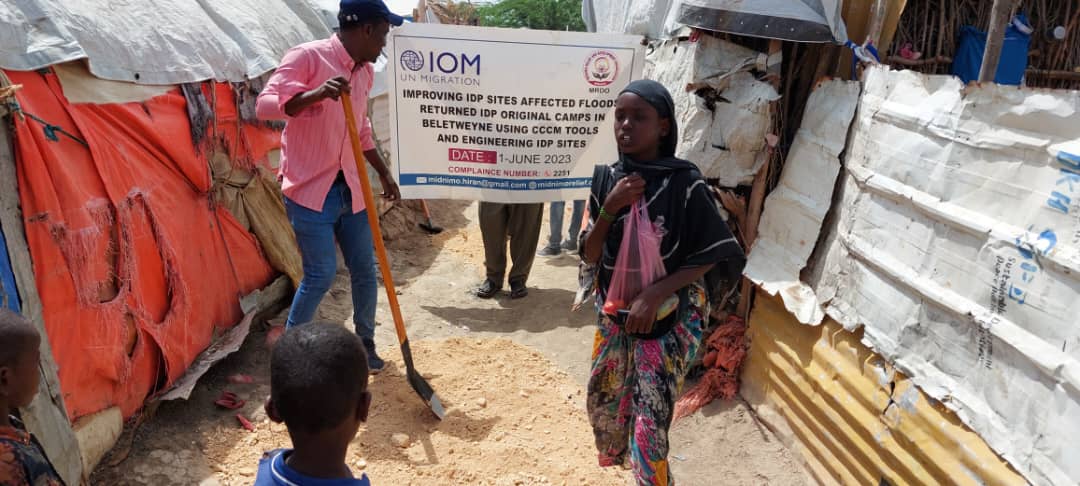
The Cash for Work (CfW) intervention by MRDO improved environmental conditions through cash for work in the IDP sites by assisting persons with disabilities with working tools and offering capacity building trainings-CMC.
MRDO team provided cash to the 130 beneficiaries comprising of 80 male and 50 female who participated in the 10 day clean-up exercise. The cash compensation was of a great support towards meeting their household daily costs.
The captured pictures below show some of the participants during the clean-up exercise.
Capacity Building Training – CMC Provision
The team in collaboration with CCCM also provided capacity building-CMC trainings to the participants from the IDP sites.
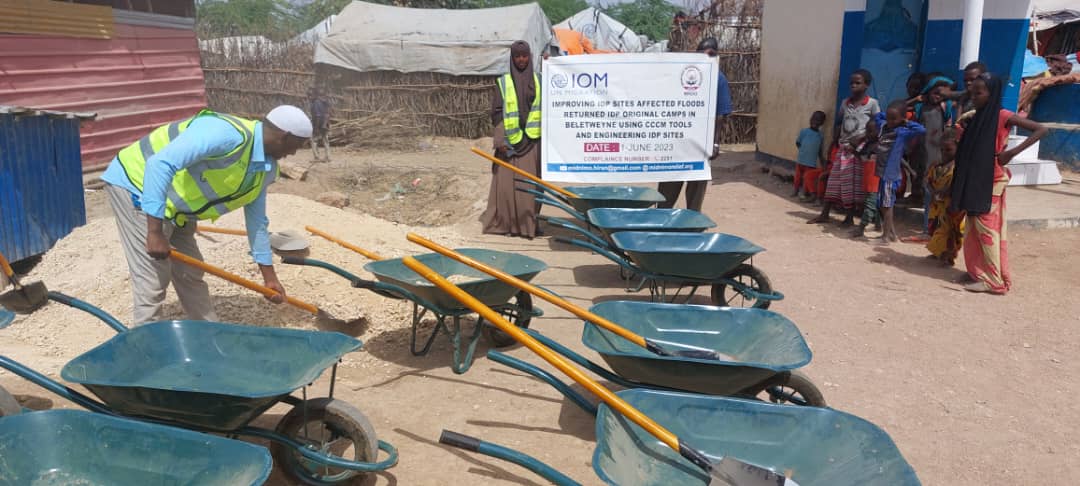
Material Assistance to Persons with Disabilities
The intervention involved provision of material assistance to people with disabilities in the IDP sites. The materials that were provided included but not limited to the following:- wheel barrows, spades, rake, brooms, among many other cleaning materials as evidenced in the below captured pictures.
Management and Strengthening of the existing Complaints and Feedback Mechanisms
To promote transparency and accountability MRDO established and maintained an effective Complaints and Feedback Mechanism (CFM) in 55 IDP sites. The CFM operated through various channels including, CFM desks, CFM field teams and a toll-free hotline (2251).
MRDO established a separate hotline for Bulo Burto, Jalalaqsi, and Jowhar (2484). The current hotline (2251) continued to serve Beletweyne and Mataban exclusively. This improved the efficiency of the CFM, reducing the caseload on the current hotline and ensuring a more timely and effective reply to the feedback, concerns, and questions raised by the IDPs. Once the new hotline was established, MRDO conducted comprehensive awareness-raising sessions with the community to inform them of the hotline number change and improved their understanding and trust in the CFM.
MRDO, with support from the CCCM Cluster, further strengthened its CFM by adopting the Zite Manager data collection tool. This tool improved the collection, analysis, processing, referral, follow-up, and response to IDP community feedback. MRDO’s CFM teams received training on how to use the Zite Manager data collection tool, including both the mobile application for gathering feedback from IDPs and the desktop application for reviewing, processing, and referring feedback.
A total of 4366 CFM cases were handled by MRDO in the year 2023. These were as tabulated below;-
Table 2 – Hirshabelle CFM 2023 Cases
| # | District | No. of CFM Cases |
| 1 | Beletweyne | 3,101 |
| 2 | Bulaburto | 279 |
| 3 | Jalalaqsi, | 423 |
| 4 | Jowhar | 563 |
| Total | 4,366 | |
Graph 2- No. of recorded CFM Cases per districts
Flood mitigation and preparedness activities through community engagement and site maintenance activities
MRDO conducted flood risk assessments across all 55 IDP sites to map and identify areas at high risk of flooding. While 16 sites have previously been identified as high-risk (13 in Beletweyne, 1 in Jowhar, and 2 in Jalalaqsi), MRDO ensured the data was up to date by engaging with local authorities and partners to explore options for long-term flood mitigation measures, such as construction of flood barriers or relocation of high-risk sites.
The organization conducted training sessions for CMCs and community members on flood preparedness and response. MRDO also conducted awareness-raising sessions on flood risks and preparedness among the wider community. In high-risk areas, MRDO developed community-based flood preparedness plans with the CMCs and local authorities. These plans included the below contingency activities, based on needs and priorities identified. In the event of no flooding, the funds allocated for these activities were reallocated based on other priorities that were jointly identified with the community and in consultation with IOM.
- Distributed emergency kits to households in high-risk areas (including items such as life jackets, hygiene kits, emergency shelter kit, etc.).
- Conducted regular site maintenance activities in high-risk areas, which involved clearing of drainage channels, construction of drainage systems in areas where they are lacking, sandbagging of shelters and key infrastructures. The site maintenance activities were carried out in a participatory manner, with the involvement of community members through a cash-for-work programme. A minimum of 30% (39 persons) of casual workers were women, with priority given to female heads of household. A minimum of 5% (7 persons) of casual workers were persons with disabilities. To carry out the site maintenance activities, MRDO provided site maintenance toolkits consisting of wheelbarrows, rakes, spades, rubber boots and gloves. MRDO recruited an engineer to conduct assessments and supervise the site maintenance activities.
Development and capacity building training of minority champions
MRDO identified and trained 10 individuals (two in each district) from minority communities who have the potential to become advocates and leaders for their community and providing them with the necessary skills and knowledge to effectively represent and advocate for their community’s rights and needs. The training took place in Beletweyne, for two days.
Participants during training session
Awareness-raising sessions on minority rights and minority inclusion
To promote minority rights and inclusion, MRDO conducted two awareness-raising sessions per month in 55 IDP sites. The focus of the sessions was on promoting tolerance, respect, and inclusion of minority groups in the community, as well as raising awareness on their rights and the challenges they face. MRDO also worked closely with minority groups to ensure their active participation and engagement in the sessions, and ensured that their perspectives and voices were heard.
Data collection on minority groups’ experiences and issues to inform evidence-based programming and advocacy efforts
MRDO conducted data collection on minority groups’ experiences and issues to inform evidence-based programming and advocacy efforts. This activity included conducting surveys, focus group discussions, and other methods to gather information on the needs and concerns of minority groups, as well as their experiences with discrimination and exclusion.
The key results from the data collection were shared with relevant stakeholders. MRDO also presented the findings and recommendations in relevant forums to promote the implementation of recommendations and support the advancement of minority rights. To ensure the protection of sensitive data, all information was anonymized and aggregated as appropriate.
Achievements and Results
As at the end of the project, MRDO had recorded a number of achievements as detailed below:-
- MRDO conducted monthly site and service monitoring in 55 IDP sites across the five districts of Hirshabelle .
- MRDO carried out assessments that helped to identify potential threats of eviction, provided early warning of any eviction attempts, and facilitated timely and appropriate interventions.
- MRDO registered newly arrived households, through the CCCM Cluster New Arrival Tracker (NAT) 2.0., to inform the drought response and help identify areas with large concentration of new arrivals.
- We also conducted safety audits to assess and identify potential risks and hazards in the sites.
- MRDO conducted capacity building of Camp Management Committees (CMC) where a total of 330 individuals across the 55 IDP sites managed by MRDO participated. Each training session lasted for two days, with multiple sessions organized in various districts to accommodate the large number of participants.
- MRDO established a separate hotline for Bulo Burto, Jalalaqsi, and Jowhar. The current hotline (2251) continued to serve Beletweyne and Mataban exclusively. This improved the efficiency of the CFM, reducing the caseload on the current hotline and ensuring a more timely and effective reply to the feedback, concerns, and questions raised by the IDPs.
- MRDO conducted flood risk assessments across all 55 IDP sites to map and identify areas at high risk of flooding.
- Distributed emergency kits to households in high-risk areas (including items such as life jackets, hygiene kits, emergency shelter kit, etc.).
- Conducted regular site maintenance activities in high-risk areas, which involved clearing of drainage channels, construction of drainage systems in areas where they are lacking, sandbagging of shelters and key infrastructures.
- MRDO identified and trained 10 individuals (two in each district) from minority communities who have the potential to become advocates and leaders for their community and providing them with the necessary skills and knowledge to effectively represent and advocate for their community’s rights and needs.
- MRDO conducted two awareness-raising sessions per month in 55 IDP sites.
- MRDO conducted data collection on minority groups’ experiences and issues to inform evidence-based programming and advocacy efforts.
6.0 IMPLEMENTATION, SUSTAINABILITY & STABILITY CHALLENGES AND CONSTRAINTS
Implementing the programmatic activities was not without challenges; as a result, MRDO experienced reduced levels of achievement and impact of our interventions. These include:-
- MRDO needs the continuous support of its partners and its members as the only fallback positions that the organization would rely on to sustain monitoring and supervision of its programs and initiatives.
- Monitoring is quite crucial as these are very new undertakings. Close monitoring from the organization office is also crucial to avoid collapsing of the projects.
- Lack of adequate funds to finance unforeseen project needs in the course of implementation.
- During the preparation and projects implementation periods, there have been no any insecurity threats and the projects were successfully undertaken in various regions as planned and scheduled.
- Among the most devastating effects of the civil wars and conflict in Somalia have undermined the human rights, political, economic and social environment as it has adversely affected the development of democracy. These effects have hampered the strengthening of socio-economic and political participation of the communities and specifically marginalized, minority and other vulnerable groups.
7.0 GENERAL RECOMMENDATIONS AND CONCLUSION
- In the immediate future, joint effort should be put forward by all the stakeholders in ensuring that a strategy is put in place to address the perennial challenges facing the organization from all fronts especially with regard to sustainability of the its programs and projects.
- It was noted that more capacity building trainings and awareness raising workshops need to be conducted as this is the glimpse of hope that will support to establish robust member organizations.
- There is need for creation of a dynamic to reflect and exchange ideas / experiences on specific issues concerning how to constructively engage stakeholders on issues affecting marginalized, minority and vulnerable groups.
- Need for Government and International Partners to design for an inclusive programs and interventions where vulnerable groups are also represented and catered for.
=END=